
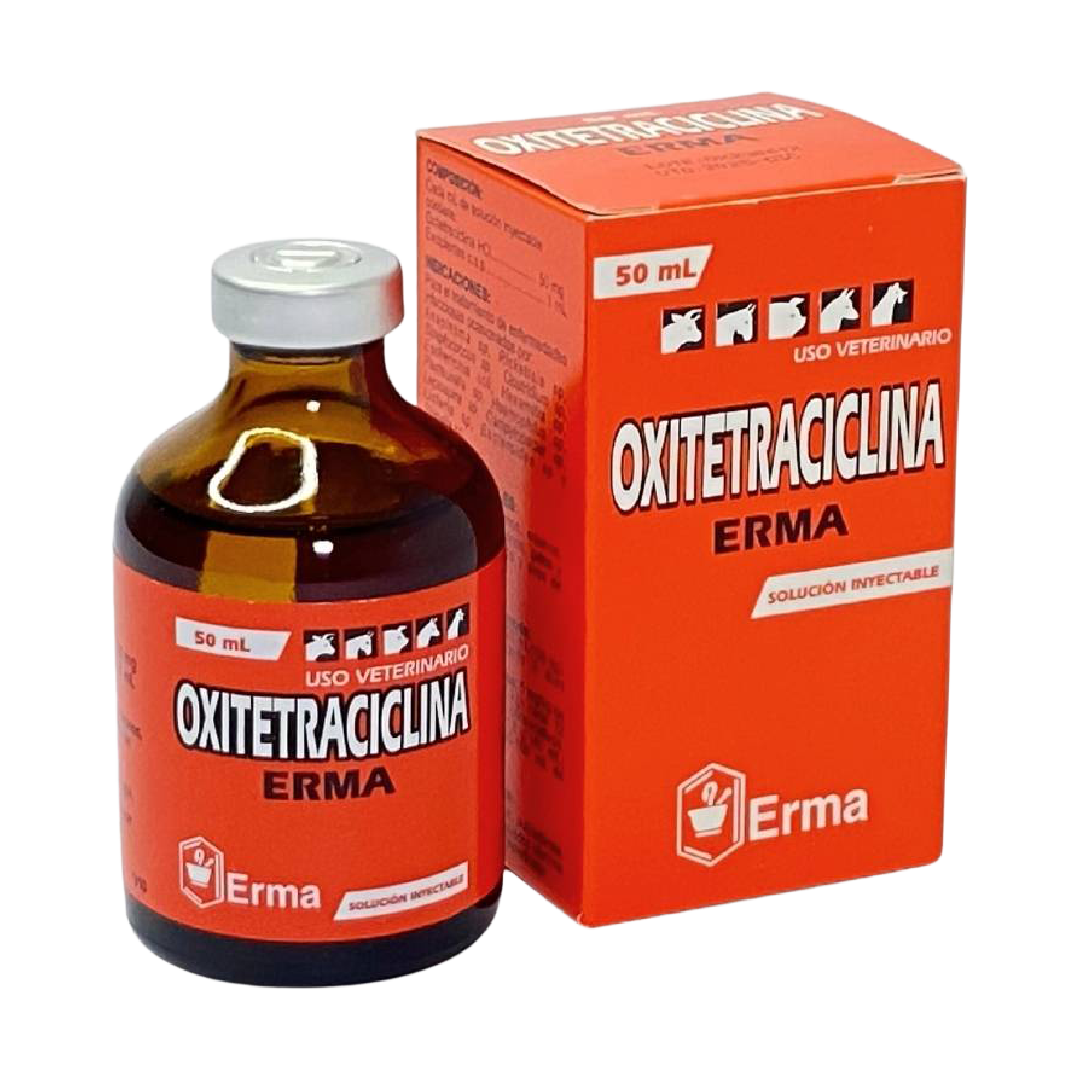
 Image 1 of 1
Broad-spectrum antibiotic.
COMPOSITION:
Each mL of OXYTETRACYCLINE-Erma contains:
Oxytetracycline base 50 mg
Vehicles q.s. to 1 mL
INDICATIONS:
Treatment of diseases caused by Anaplasma spp., Rickettsia spp., Streptococcus spp., Clostridium spp., Escherichia coli, Hexamita spp., Pasteurella spp., Haemophilus spp., Leptospira spp., Campylobacter spp., Listeria spp., Bacteroides spp., and Shigella spp.
Other indications at the discretion of the veterinarian.
USES:
Effective in the treatment of diseases caused by rickettsiae, bacteria, amoebae, and mycoplasmas.
Drug of choice for anaplasmosis, brucellosis, actinobacillosis, actinomycosis, anthrax, blackleg, malignant edema, hemorrhagic septicemia, tetanus, bacillary hemoglobinuria, colibacillosis, colisepticemia, shigellosis, listeriosis, vibriosis, vibrionic dysentery, Glässer’s disease, erysipelas (swine), vaginitis, peritonitis, pyelonephritis, infectious mastitis, and skin infections.
MECHANISM OF ACTION:
Chelates cations, inhibits enzymatic systems, and suppresses bacterial protein synthesis by blocking the 30S and 50S ribosomal subunits.
DOSAGE AND ROUTE OF ADMINISTRATION:
Routes: Intravenous (IV), deep intramuscular (IM), subcutaneous (SC), intraperitoneal (IP), and intrauterine lavage, as directed by the veterinarian.
Anaplasmosis: 10 mg/kg (20 mL per 100 kg body weight) every 12 hours for 5 consecutive days.
Other susceptible infections: 5 mg/kg (10 mL per 100 kg body weight) every 12 hours for 5 consecutive days.
Intrauterine lavage:
Dilute 2 g (40 mL) of oxytetracycline in 100 mL of sterile distilled water.
Maximum volume per injection site:
Cattle: 20 mL
Swine: 10 mL
Sheep and goats: 5 mL
PRECAUTIONS:
May cause increased blood urea nitrogen (BUN), decreased prothrombin activity, jaundice, and photosensitivity.
Local irritation and lameness due to injection-site pain may occur.
WITHDRAWAL PERIOD:
Meat: 21 days
Milk: 6 days
Do not use in laying hens producing eggs for human consumption.
PRESENTATION: 50 mL and 100 mL
USE IN: Poultry, cattle, dogs, horses, and swine.
Broad-spectrum antibiotic.
COMPOSITION:
Each mL of OXYTETRACYCLINE-Erma contains:
Oxytetracycline base 50 mg
Vehicles q.s. to 1 mL
INDICATIONS:
Treatment of diseases caused by Anaplasma spp., Rickettsia spp., Streptococcus spp., Clostridium spp., Escherichia coli, Hexamita spp., Pasteurella spp., Haemophilus spp., Leptospira spp., Campylobacter spp., Listeria spp., Bacteroides spp., and Shigella spp.
Other indications at the discretion of the veterinarian.
USES:
Effective in the treatment of diseases caused by rickettsiae, bacteria, amoebae, and mycoplasmas.
Drug of choice for anaplasmosis, brucellosis, actinobacillosis, actinomycosis, anthrax, blackleg, malignant edema, hemorrhagic septicemia, tetanus, bacillary hemoglobinuria, colibacillosis, colisepticemia, shigellosis, listeriosis, vibriosis, vibrionic dysentery, Glässer’s disease, erysipelas (swine), vaginitis, peritonitis, pyelonephritis, infectious mastitis, and skin infections.
MECHANISM OF ACTION:
Chelates cations, inhibits enzymatic systems, and suppresses bacterial protein synthesis by blocking the 30S and 50S ribosomal subunits.
DOSAGE AND ROUTE OF ADMINISTRATION:
Routes: Intravenous (IV), deep intramuscular (IM), subcutaneous (SC), intraperitoneal (IP), and intrauterine lavage, as directed by the veterinarian.
Anaplasmosis: 10 mg/kg (20 mL per 100 kg body weight) every 12 hours for 5 consecutive days.
Other susceptible infections: 5 mg/kg (10 mL per 100 kg body weight) every 12 hours for 5 consecutive days.
Intrauterine lavage:
Dilute 2 g (40 mL) of oxytetracycline in 100 mL of sterile distilled water.
Maximum volume per injection site:
Cattle: 20 mL
Swine: 10 mL
Sheep and goats: 5 mL
PRECAUTIONS:
May cause increased blood urea nitrogen (BUN), decreased prothrombin activity, jaundice, and photosensitivity.
Local irritation and lameness due to injection-site pain may occur.
WITHDRAWAL PERIOD:
Meat: 21 days
Milk: 6 days
Do not use in laying hens producing eggs for human consumption.
PRESENTATION: 50 mL and 100 mL
USE IN: Poultry, cattle, dogs, horses, and swine.